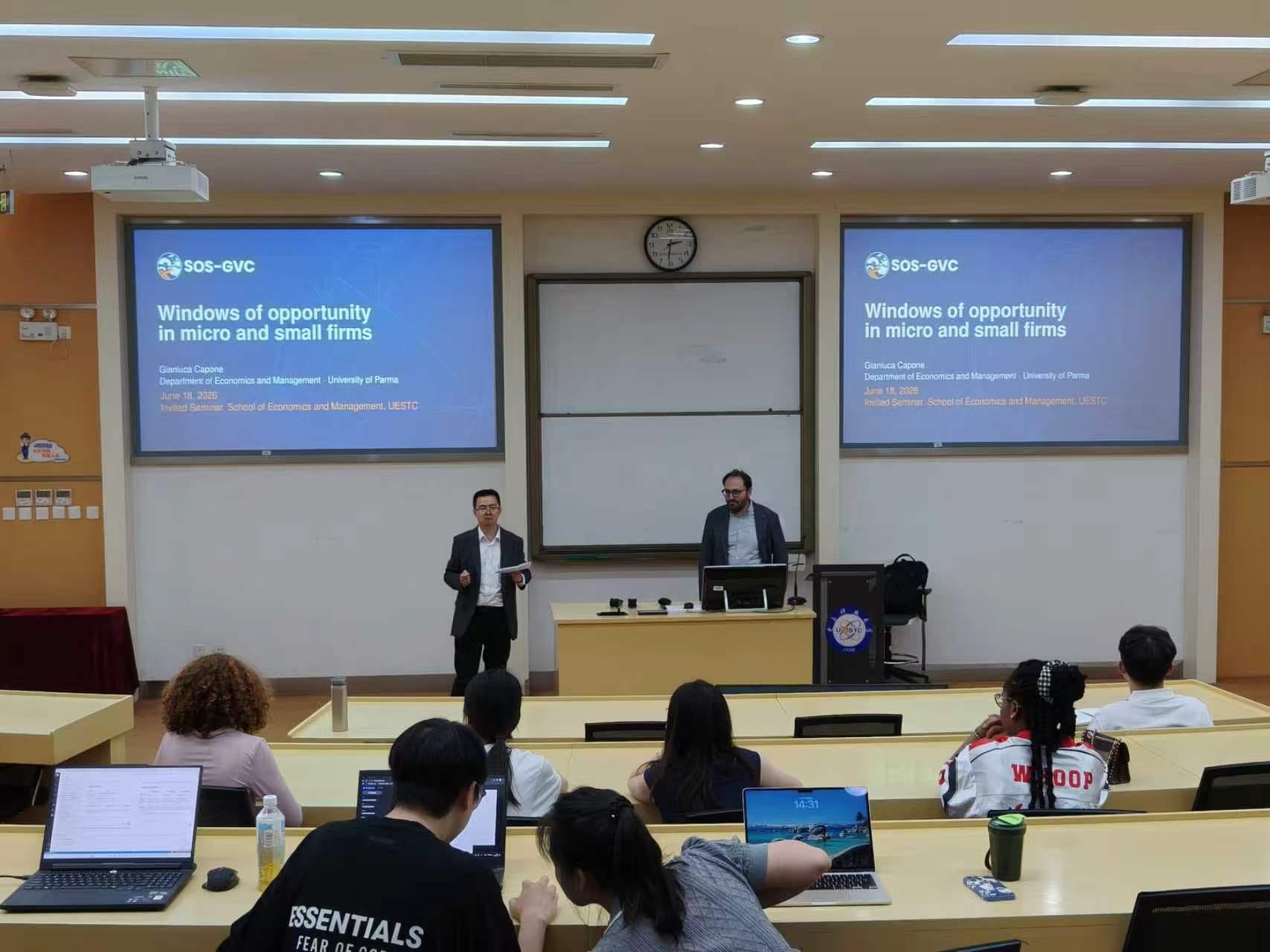
On 18 June 2026, Gianluca Capone represented the SOS-GVC research team at an invited seminar hosted by the School of Economics and Management, University of Electronic Science and Technology of China (UESTC), Chengdu.
Windows of Opportunity for Micro and Small Firms
The seminar presented the outcomes of a project focusing on global value chains and micro and small firms, combining an empirical analysis with a history-friendly simulation model.
The empirical study investigates how the entry and exit of foreign multinational enterprises (MNEs) generate local windows of opportunity for subcontractors in the Italian fashion industry, influencing their upgrading trajectories. Using firm-level data on small subcontractors, we distinguish four dimensions of upgrading: engagement in higher value-added activities, diversification of client and activity portfolios, and the shift from component toward final goods production. The results show that the entry of foreign MNEs does not generate significant local upgrading opportunities. Conversely, MNE exits significantly foster upgrading, but only for subcontractors embedded in industrial districts and linked to clients beyond their regional boundaries.
The model extends the analysis to the technological windows of opportunity opened by Industry 4.0 technologies. The paper develops a history-friendly model (HFM) that reproduces key empirical features of the Italian fashion value chain and simulates alternative technological trajectories. The model incorporates heterogeneous suppliers and clients, spatial constraints, capability accumulation, and differentiated Industry 4.0 shocks.
Results show that upgrading in the baseline scenario is shaped primarily by geography and access to non-local or multinational clients. Production-Efficiency Enhancers, such as robotics and IoT monitoring, do not expand overall upgrading but disproportionately benefit geographically constrained firms by reducing cost disadvantages. In contrast, Capability-Building Technologies, such as digital prototyping and additive manufacturing, reduce upgrading opportunities by enabling client firms to internalize functions, despite raising suppliers’ learning capacity.
These findings highlight the asymmetric and technology-specific nature of digital transformation and call for differentiated industrial policies that consider both spatial inequalities and supply-chain power dynamics.